Mini Cart

You’ve found the perfect frame, opened the back and gone to slot your photo in. Then it slides around, gets hidden at the edges, or won’t go in at all. It’s one of the most common framing frustrations, and it almost always comes down to one thing: misunderstanding frame size vs print size.

The good news is that once you know how frames are measured, choosing the right one takes about two minutes. This guide explains the difference, the five most common reasons a photo doesn’t fit, and a simple fix for each.

Frame Size vs Print Size: What’s the Difference?

In the UK, a picture frame is named after the picture it holds, not its outside measurements. A 10×8 frame is made to hold a 10×8 inch print. The frame itself is larger, because the moulding (the border) adds width on every side.

So when people compare frame size vs print size, they’re really dealing with three measurements:

  • Print size: the size of your photo, artwork or certificate.
  • Frame size: the size of picture the frame is designed to hold. This should match your print.
  • Outer size: the full measurement including the moulding. It’s useful for planning wall space, but not for fitting your photo.

If your frame has a mount, there’s a fourth measurement: the aperture. This is the window cut into the mount, and it’s slightly smaller than the print so the mount can hold the picture in place.

Rule of thumb: Buy the frame that matches your print size exactly. Our picture frame size guide lists every size in inches, centimetres and A-sizes.

5 Reasons Your Photo Doesn’t Fit the Frame

1. Inches and centimetres don’t line up

UK frames come in both imperial sizes (6×4, 7×5, 10×8) and metric sizes (30×40cm, 50×70cm), and the two don’t swap over neatly. A 30×40cm frame is about 11.8×15.7 inches. That’s close to 12×16, but not the same, and a few millimetres is enough to make a print buckle or slip. This is the most common frame size vs print size mix-up we see.

2. A4 isn’t 10×8, and A-sizes aren’t inch sizes

A4 measures 21×29.7cm, while a 10×8 frame holds 20.3×25.4cm. They look similar, but A4 is noticeably taller. Certificates, documents and most home-printed pages are A-sized, so they need an A-series frame. It’s a classic frame size vs print size trap, and we cover it in detail in A4 vs 8×10: What’s the Difference?

3. Your photo’s shape doesn’t match the frame’s shape

This one catches out almost everyone who prints from a phone. Every print size has an aspect ratio, which is the relationship between its width and height:

Print size Aspect ratio Best for
6×4 in 3:2 Camera photos
7×5 in 7:5 Portraits, gifts
10×8 in 5:4 Portraits, family photos
A5–A1 1:1.41 Certificates, art prints
12×12 in 1:1 Square and social media photos
8×6 in 4:3 Smartphone photos

Most smartphones shoot at 4:3, so a phone photo printed at 6×4 either gets cropped or gets white borders added. Understanding frame size vs print size starts with checking the shape, not just the numbers.

4. You measured the frame, not the print

Measuring the outside of a frame and comparing it with your print will always give a mismatch. Measure your print, then choose the frame with the same stated size.

5. The mount window is smaller than the print

If your frame comes with a mount, its window is slightly smaller than the print, usually by a few millimetres on each side. The mount overlaps the edges to hold the picture in place, so a thin strip around the edge will be hidden. If there’s important detail near the edge, such as a signature, a face or text, allow for it when you print.

How to Measure Your Print Correctly

  1. Lay the print flat on a hard surface.
  2. Use a metal ruler or tape measure to measure the width and the height, edge to edge.
  3. Measure in both centimetres and inches. Whichever gives a round number tells you which sizing system it was printed in. For example, 21×29.7cm is A4 and 7×5 inches is a standard photo size.
  4. Match the result to a frame with the same stated size.

Getting frame size vs print size right comes down to this one habit: measure the print, not the frame.

How to Fix a Photo That Doesn’t Fit

Most frame size vs print size problems can be fixed in minutes.

If the print is too big

  • Trim it. Mark a light pencil line on the back, then cut with a paper trimmer, or a craft knife against a metal ruler.
  • Reprint it at the right size. Most online print services let you choose the exact size and adjust the crop.
  • Size up. Choose the next frame size up and use a mount to fill the extra space.

If the print is too small

  • Add a mount. It fills the gap and gives a gallery-style finish. A 7×5 photo in a 10×8 frame with a mount is a timeless look.
  • Use backing card. Fix the print centrally onto card cut to the frame size, using acid-free tape.
  • Choose a smaller frame. Our mini picture frames are made for small prints.

If the shape is wrong

Quick Reference: Common UK Print Sizes

Print Centimetres Inches Frame you need
6×4 15.2 × 10.2 6 × 4 6×4 frame
7×5 17.8 × 12.7 7 × 5 7×5 frame
10×8 25.4 × 20.3 10 × 8 10×8 frame
A5 14.8 × 21 5.8 × 8.3 A5 frame
A4 21 × 29.7 8.3 × 11.7 A4 frame
A3 29.7 × 42 11.7 × 16.5 A3 frame
A2 42 × 59.4 16.5 × 23.4 A2 frame
A1 59.4 × 84.1 23.4 × 33.1 A1 frame
Maxi poster 61 × 91.5 24 × 36 Maxi poster frame

Keep this table handy and frame size vs print size mistakes will be a thing of the past. For poster sizes in particular, see Poster Sizes Explained.

Common Mistakes to Avoid

  • Assuming “close enough” will do. A print even 5mm too big will buckle behind the glass.
  • Forcing a print in. This leaves creases that can’t be undone.
  • Forgetting the mount overlap. Check how close important details sit to the edge of the print.
  • Confusing pixels with print size. For a sharp print, aim for about 300 pixels per inch. A 6×4 print needs roughly 1800×1200 pixels.

Each of these is a frame size vs print size issue you can avoid with a tape measure and a quick check.

Want to see how different frame styles look on the wall? Follow us on Pinterest for gallery wall layouts, mount colours, and styling ideas.

Frequently Asked Questions

Does frame size mean the inside or outside measurement?
The inside, meaning the size of picture the frame holds. This is the key to frame size vs print size: the outer measurement is always larger because of the moulding.

Should a frame be bigger than the picture?
When it comes to frame size vs print size, the stated frame size should match your print. If you want a border around your picture, choose a larger frame with a mount.

Can I put an A4 print in a 10×8 frame?
Not without trimming it. An A4 print is about 4.3cm too tall and 7mm too wide for a 10×8 frame. Use an A4 frame instead.

Why does my phone photo get cropped when printed at 6×4?
Phones usually shoot at 4:3, while 6×4 is 3:2. To avoid cropping, print at a 4:3 size such as 8×6 inches, or re-crop the photo yourself before printing.

How do I check frame size vs print size before ordering online?
Measure your print, compare it with the frame size in the product listing, and check our size guide if you’re unsure.

Get the Perfect Fit Every Time

Once you understand frame size vs print size, choosing a frame is simple: measure your print, check its shape, and pick the frame that matches. With more than 100 sizes in inches, centimetres and A-sizes, you’ll find the right fit for every photo, print and poster at PhotoFramed.

👉 Browse all frame sizes or use our picture frame size guide. Still not sure? Contact our friendly team and we’ll help you find the perfect frame.


Continue Reading →

Personalised Photo Gift Ideas for Christmas (for Mum, Dad, Grandparents, Couples)

Every December, the same question comes round: what do you buy for the people who say they “don’t need anything”? Socks and smellies get forgotten by February. A favourite photo, framed and wrapped, ends up on a mantelpiece for years.

That is why personalised photo gifts are among the most popular Christmas presents in the UK. They are affordable, they suit every age, and no two are ever the same, because the memory inside the frame belongs only to your family.

In this guide we have gathered our favourite photo gift ideas for the people on your list, whether you are shopping for mum, dad, grandparents or your other half. You will also find practical tips on choosing the right photo, picking a frame size and getting everything ready before Christmas.

Why a framed photo makes the perfect Christmas gift

A framed photo gift does something most presents cannot: it shows you remembered a moment the other person cared about. Here is why it works so well:

  • It is genuinely personal. You choose the picture, so the gift is unique to the person receiving it.
  • It lasts. A good frame protects the print from dust and fading and keeps it on display for years.
  • It suits any budget. A small 6×4 frame makes a lovely stocking filler, while a large maxi or panoramic frame becomes a statement piece.
  • It is easy to get right. No guessing clothes sizes or worrying about duplicates.

All you need is a printed photo and a frame that fits it. Below are ideas for everyone on your list.

Photo gift ideas for mum

Mums tend to treasure the photos everyone else forgets to print. These Christmas photo gifts are made for her.

1. A “then and now” pair
Frame a childhood photo of you (or your siblings) next to a recent one recreating the same pose. Two matching rectangular picture frames side by side make this simple but very emotional.

2. A family gallery wall starter set
If mum has been “meaning to sort the photos out” for years, give her a head start. Choose three to five frames in mixed sizes, such as a 10×8 centrepiece with 7×5 and 6×4 frames around it, and fill them with family favourites.

3. Her wedding photo, finally framed properly
Many parents still have their wedding photos tucked away in an album. Get one scanned and printed, then display it in one of our wedding photo frames for a gift that will almost certainly bring a tear.

4. Grandchildren on the bedside table
For mums who have recently become grandmothers, a small framed photo of the new arrival is hard to beat. Our mini picture frames fit neatly on a bedside table or windowsill.

Photo gift ideas for dad

Dads can be the hardest people to buy for, but a framed photo gift often lands better than another gadget.

1. His proudest moment
A match day with the kids, a finished DIY project, a fishing trip, his first car. Frame the photo that sums up what he loves, and he will tell the story behind it every time someone visits.

2. A panoramic shot of a favourite place
If there is a view the family always returns to, such as a beach, a mountain or a football ground, a wide shot looks spectacular in a panoramic photo frame. It is a great choice for a home office or hallway.

3. Something for his desk
A compact 7×5 or 6×4 frame with a family photo is a thoughtful gift for dads who work at a desk all day, whether at home or in the office.

4. Framed memorabilia
Match tickets, a signed programme, a vintage map or an old family photo can all be framed. Our A-series frames are ideal for documents, certificates and prints from A5 up to A1.

Photo gift ideas for grandparents

For grandparents, nothing beats seeing the people they love most. These are some of the most meaningful photo gift ideas of all.

1. The year in pictures
Pick your best photos from 2026, such as birthdays, holidays, first days at school and new babies, and frame them as a set. It is a lovely way to share a year they may have only seen in snippets.

2. A generations photo
Gather grandparents, parents and children for one photo (Christmas Day itself is perfect for next year), or frame three individual portraits together. A square picture frame gives a clean, modern look.

3. Big and easy to see
Larger prints are easier to enjoy, especially for anyone whose eyesight is not what it was. Consider a 10×8, A4 or larger frame so faces are clear from across the room.

4. Children’s artwork, framed
A drawing, handprint or Christmas card made by the grandchildren becomes a keepsake once it is framed. Tip: measure the artwork first and match it to a standard size, as many children’s drawings are on A4 paper.

5. A restored old family photo
Have an old black-and-white photo scanned, restored and reprinted, then frame it in a classic wooden picture frame. It links generations and often sparks wonderful family stories over Christmas dinner.

Photo gift ideas for couples

Whether it is your partner, your best friends or newlyweds, framed photos make romantic, personal Christmas gifts for couples.

1. Where it all began
Frame a photo from your first date, first holiday or the place you met. If you do not have a photo, a printed map of the location makes a stylish alternative.

2. Their wedding day in a statement frame
For couples who married this year, a large framed wedding photo is a gift they will hang straight away. Our wedding photo frames and maxi picture frames are designed for exactly this kind of display.

3. A travel collage
Print your favourite shots from trips you have taken together and arrange them in matching frames. It makes a brilliant feature wall, and you can add a new frame after every holiday.

4. A poster of “your” song, film or city
Couples who love a particular band, film or city often have a poster lying around. Give it a proper home in a maxi poster frame.

How to choose the right photo and frame

A few small decisions make the difference between a nice gift and a great one.

Choose a high-quality image. Phone photos usually print well up to around A4 or 10×8. For bigger frames, use the original file rather than a screenshot or a photo saved from social media, as these are compressed and can look blurry when enlarged.

Match the frame to the print size. Frame sizes refer to the size of the picture they hold, not the outside measurement of the frame. If your print is 7×5 inches, choose a 7×5 frame. Our picture frame size guide explains every size, and our guide to standard photo print sizes shows which frames fit 6×4, 7×5, 10×8 and 12×16 prints.

Check A4 vs 8×10. They look almost identical but are not interchangeable. If you are unsure, our article on A4 vs 8×10 frames explains the difference.

Think about where it will go. Small frames suit shelves and bedside tables; medium frames suit walls and desks; large and panoramic frames work as a focal point in a living room or hallway.

Pick a style that suits their home. Classic wood feels warm and traditional, while clean, simple frames suit modern interiors. When in doubt, a neutral frame lets the photo do the talking.

Want to see how different frame styles look on the wall? Follow us on Pinterest for gallery wall layouts, mount colours, and styling ideas.

Get your Christmas photo gifts sorted early

Framed photos are one of the easiest gifts to prepare, but they do involve two steps: printing the photo and getting the frame. To avoid a last-minute rush:

  1. Choose your photos this week. Going through your camera roll takes longer than you think.
  2. Order prints and frames together, so everything arrives around the same time.
  3. Allow time for delivery. Most PhotoFramed orders arrive within 3 to 5 working days, but couriers get busier in December, so ordering early gives you a comfortable buffer.
  4. Assemble and wrap at home. Slip the photo in, close the back, and you are ready to wrap.

Frequently asked questions

What are the best photo gift ideas for someone who has everything?
A framed photo of a shared memory is ideal, because it cannot be bought anywhere else. Old family photos, “then and now” pairs, and framed children’s artwork are especially popular.

What size frame is best for a photo gift?
For a desk or shelf, 6×4 or 7×5 frames work well. For a wall, 10×8, A4 or larger is better. Always match the frame to the size of your print.

Can I frame a photo taken on my phone?
Yes. Most modern phone photos print clearly at standard sizes. Use the original image file for the best quality, especially for larger prints.

Are framed photos a good gift for grandparents?
They are one of the most loved gifts for grandparents. Larger prints of grandchildren, family portraits or a “year in pictures” set are always well received.

How much do photo frames cost?
Prices at PhotoFramed start from just £2.15 for small frames, with large maxi frames from £39.99, so there is a framed photo gift for every budget.

Make this Christmas one to remember

The best Christmas presents are not always the most expensive. They are the ones that make someone stop, smile and say, “I remember that day.” With these photo gift ideas, you can turn your favourite memories into personalised photo gifts for mum, dad, grandparents and couples, all without breaking the bank.

Ready to get started? Browse our full range of picture frames in more than 100 sizes, or shop by size to find the perfect fit for your photo.

Continue Reading →

At first glance they look almost identical. You have a print or a certificate that’s roughly the size of a sheet of printer paper, so you order a frame that seems close enough. Then it arrives and the picture either slides around inside it or won’t fit at all.

We hear about the A4 vs 8×10 problem constantly at PhotoFramed. It’s one of the most common sizing mix-ups in framing, and it’s an easy one to make. The good news is that once you understand how the two sizes differ, you’ll never order the wrong frame again. This guide covers the exact measurements, why the difference matters, and how to choose the right frame for what you’re displaying.

A4 vs 8×10 at a Glance

  A4 8×10
Millimetres 210 × 297 mm 203 × 254 mm
Inches 8.27 × 11.69 in 8 × 10 in
Aspect ratio 1 : 1.414 4 : 5 (1 : 1.25)
Origin International (ISO 216) paper standard Imperial photographic standard
Typical use Documents, certificates, art prints, home printing Photo prints, portraits, school photos

The headline figure: A4 is about 7 mm wider and 43 mm taller than 8×10. That works out to roughly 21% more surface area.

What Is A4?

A4 is part of the ISO 216 “A series” of paper sizes, used in most countries outside North America. It’s the standard size for office paper, letters, and most home printers.

The A series has a neat property. Every size has the same proportions (a ratio of 1 to the square root of 2), so if you fold an A3 sheet in half you get an A4, and if you fold an A4 in half you get an A5. That’s why A4 looks fairly tall and slim compared with standard photo sizes.

You’ll usually find A4 used for:

  • Certificates and diplomas
  • Art prints and posters bought online, especially from UK and European sellers
  • Anything printed at home on a standard printer
  • Children’s artwork done on printer paper

What Is 8×10?

An 8×10 is a photographic print measuring 8 inches by 10 inches. It’s one of the most popular enlargement sizes and has been a staple of photo labs and portrait studios for decades.

Its proportions are 4:5, which makes it noticeably squatter than A4. It’s a classic size for portraits, wedding photos, school pictures, and headshots. If you’ve ordered an enlargement from a photo lab or had professional portraits taken, there’s a good chance you were given 8×10 prints. For a full rundown of other common photo sizes, see our guide to standard photo print sizes.

Why the A4 vs 8×10 Mix-Up Happens

There are a few reasons people confuse these two sizes:

  1. They’re close in width. There’s only about 7 mm between them across the short side, so if you hold them up side by side, they look like near twins.
  2. Different measurement systems. A4 is defined in millimetres and 8×10 in inches. Unless you convert, it’s hard to compare them at a glance.
  3. Both are a “standard” size. Shops often list them next to each other, and many people assume the two names refer to the same thing.
  4. Printer paper habits. Many people print photos at home on A4 paper and assume they’ve made an 8×10, or vice versa.

The Real Difference: Shape, Not Just Size

In any A4 vs 8×10 comparison, shape matters more than size. The two formats have different aspect ratios, and that’s what causes problems in a frame.

An A4 sheet is about 1.41 times as tall as it is wide. An 8×10 is only 1.25 times as tall as it is wide. So even if you scaled one up or down to match the other’s width, the heights would never line up. A4 is the longer, leaner shape; 8×10 is shorter and boxier.

This also affects your photos. Most digital cameras shoot in a 3:2 ratio (1.5), and most phones shoot in 4:3 (1.33). Neither matches 8×10 or A4 exactly, so some cropping is always involved:

  • Camera photos (3:2) fit A4 with only a slight trim, but lose a bigger slice when printed at 8×10.
  • Phone photos (4:3) sit between the two, losing a little off the long side for 8×10 and a little off the short side for A4.

If you’re printing a group shot where people stand right at the edges, it’s worth checking the crop preview before you order.

Can You Put an A4 Print in an 8×10 Frame?

Not without trimming it. This is the most common A4 vs 8×10 mistake we see. An A4 sheet is 297 mm long, while an 8×10 frame is built for a 254 mm print, so the A4 is about 43 mm too long and slightly too wide to fit.

You could trim the A4 down to 8×10, but you’ll lose part of the image or text. That’s fine for a photo with plenty of background, but it’s a bad idea for a certificate, a signed print, or anything with a border or margin.

Can You Put an 8×10 Print in an A4 Frame?

Technically, yes. It will go in, but it won’t look right. In the reverse A4 vs 8×10 scenario, the 8×10 print is smaller than the frame’s opening, so you’ll have a gap of around 43 mm at the top or bottom and a few millimetres on each side. The print can slip out of position, and the gap draws the eye.

The fix is a mount (more on that below). With the right mount, an 8×10 print can look excellent in a larger frame.

Which Frame Do You Need?

The simplest rule: match the frame to what you’re framing, not to what looks close. Here’s how that plays out in practice.

Photographs

When weighing A4 vs 8×10 for photos, 8×10 usually wins. Most professional prints, studio portraits, and lab enlargements come in 8×10, and you’ll find frames to fit them in our rectangle picture frames. If you’re ordering a new print, choose 8×10 unless you have a specific reason not to.

The exception is a photo you printed at home on A4 photo paper. In that case, choose an A4 frame.

Certificates, Diplomas, and Documents

For certificates, A4 vs 8×10 isn’t really a contest. In most of the world, certificates, awards, and official documents are printed on A4. Choose from our A-series frames, or a larger frame with an A4 mount if you want a more formal look. Never trim a certificate to make it fit.

One exception: certificates issued in the US and Canada are often printed on US Letter (8.5 × 11 in), which is a different size again. Measure before you buy.

Art Prints and Posters

Check the listing or the print itself. Prints from UK and European sellers are usually A-series sizes, while US sellers lean towards inch sizes like 8×10 and 11×14. If you’re unsure, measure. For larger prints, our poster sizes guide explains which frame fits which poster.

Kids’ Artwork

Most children’s drawings are done on A4 printer paper, so an A4 frame is usually the right choice. A deep mount around it makes a simple drawing look like gallery art.

Mounts: The Secret Weapon in the A4 vs 8×10 Decision

A mount (sometimes called a mat) is the card border that sits between the glass and your print. It does three useful things:

  • Holds the print in place so it can’t slide around.
  • Keeps the print off the glass, which protects it from moisture and sticking.
  • Adds breathing space around the image, which makes almost anything look more polished.

Mounts are also how you deal with in-between sizes. Some popular combinations:

  • 8×10 print → 11×14 frame with a mount. This is the classic portrait setup and a popular choice for 8×10 photos.
  • A4 print → 30×40 cm frame with a mount. A clean, modern look that works well for art prints and certificates.
  • A4 print → A3 frame with a mount. Great for giving a certificate or small artwork more presence on the wall.

The mount opening is cut slightly smaller than the print, usually overlapping a few millimetres on each side, so the edges are hidden and the print stays secure.

Want to see how different frame styles look on the wall? Follow us on Pinterest for gallery wall layouts, mount colours, and styling ideas.

Measure Before You Buy

You can settle the A4 vs 8×10 question in about thirty seconds with a ruler or tape measure:

  1. Measure the short side of your print.
  2. Measure the long side.
  3. Compare: if it’s about 21 × 29.7 cm, it’s A4. If it’s about 20.3 × 25.4 cm (8 × 10 in), it’s 8×10.

The long side is the giveaway. A4 is close to 30 cm long; 8×10 is just over 25 cm. If you measure something else entirely, it may be US Letter, 5×7, or another size. Check our picture frame size guide, or get in touch with our team and we’ll help you find the right fit.

Quick A4 vs 8×10 Checklist

  • Professional photo or studio portrait? → 8×10 frame (or 11×14 with mount)
  • Certificate or official document? → A4 frame (or larger with A4 mount)
  • Home-printed photo on printer paper? → A4 frame
  • Art print from a UK/European seller? → Probably A4; measure to confirm
  • Art print from a US seller? → Probably 8×10 or another inch size; measure to confirm
  • Not sure? → Measure the long side: ~30 cm is A4, ~25 cm is 8×10

Frequently Asked Questions

Is A4 bigger than 8×10?

Yes. When comparing A4 vs 8×10, A4 is slightly wider and noticeably taller. It has about 21% more area.

Which is more common for photo frames?

For photos, 8×10 is far more common. On the A4 vs 8×10 question for documents and home printing, A4 is the standard in most countries.

Is 8×10 the same as US Letter?

No. US Letter is 8.5 × 11 inches, which is larger than 8×10 and a different shape from A4.

Can I use a mount for an unusual size?

Yes. A mount lets you put a smaller print in a standard frame, with the opening sized to your artwork.

The Bottom Line

The A4 vs 8×10 debate comes down to one simple point: they’re similar, but they’re not interchangeable. A4 is the taller, international paper size you’ll find on certificates, documents, and many art prints. 8×10 is the shorter, boxier photographic size used for portraits and enlargements.

Measure your print, pick the frame that matches it, and add a mount if you want extra polish or need to bridge a size gap. Do that, and your picture will sit perfectly in its frame the first time.

Browse our A-series frames, rectangle picture frames, or all frame sizes to find the perfect fit for your print.

Continue Reading →

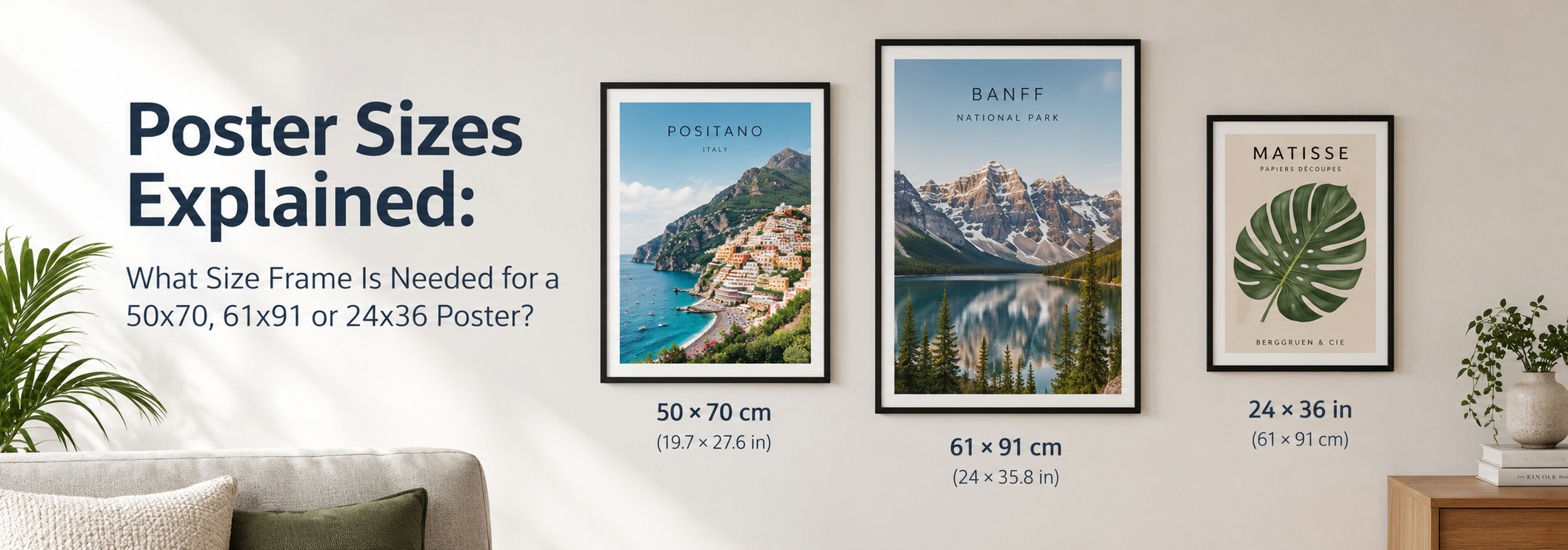
Poster sizes can be confusing. One shop sells in centimetres, another in inches, and a third uses A-sizes, so it is easy to order a frame that is almost right but still doesn’t fit. This guide explains the most popular poster sizes in the UK, shows exactly which frame fits a 50×70, 61×91, or 24×36 poster, and gives you a simple chart you can use for any print on your wall.

Quick answer: which poster sizes fit your frame?

50 x 70 cm poster → a 50 x 70 cm frame.

61 x 91 cm poster → a 24 x 36 inch frame. 61 x 91 cm is simply 24 x 36 inches in metric.

24 x 36 inch poster → a 24 x 36 inch frame for portrait, or a 36 x 24 inch frame for landscape.

The golden rule: a frame’s size is the size of the artwork it holds, not the outside of the frame.

How poster sizes and frame sizes work

When you buy a frame labelled 50 x 70 cm, that measurement is the opening inside the frame, built to hold a 50 x 70 cm print. The outside of the frame is bigger because of the moulding. On our 50 x 70 cm maxi frame, the moulding is 30 mm wide, so the finished piece measures roughly 56 x 76 cm on the wall. Keep that in mind when you plan a space above a sofa or bed.

A small lip called the rebate holds the glazing, poster and backing in place. It also overlaps the very edge of your print by a few millimetres, so avoid posters with text or important detail right at the border.

50×70 poster: what size frame do you need?

50 x 70 cm is the most popular poster sizes for art prints sold by European and UK online shops. It has a 5:7 ratio and measures about 19.7 x 27.6 inches. It is large enough to make an impact in a living room but still fits comfortably on most walls.

Frame to choose: a Maxi Picture Frame 50 x 70 cm. Ours is made from MDF with a 30 mm moulding, 15 mm depth, and an 8 mm rebate, and uses HD plexiglass instead of glass, so it is lighter and shatter-resistant. It hangs in portrait or landscape and comes in black, white, oak, and rustic finishes.

A 50 x 70 cm frame is also a smart choice for smaller prints. Add a mount, and it will display an A2 poster or a 40 x 50 cm print with a clean gallery-style border.

61×91 poster: what size frame do you need?

This is the size that causes the most mistakes. A 61 x 91 cm poster is not a metric standard of its own. It is a 24 x 36 inch poster converted into centimetres (60.96 x 91.44 cm, rounded to 61 x 91).

Frame to choose: a 24 x 36 inch frame. It fits a 61 x 91 cm poster exactly.

Avoid this common mistake: a 60 x 90 cm frame looks close enough, but a 61 x 91 cm poster is about 1 cm too wide and 1.4 cm too tall for it. The poster will either need trimming or will buckle under the glazing. Keep the 60 x 90 cm frame for prints that are actually 60 x 90 cm.

24×36 poster: what size frame do you need?

24 x 36 inches is the classic large poster sizes in the UK and is widely used for film, music, gaming, and sports posters. It has a 2:3 ratio, the same shape as a standard photograph, which is why it also suits enlarged photos.

Frame to choose: a Maxi Picture Frame 24 x 36 inches for a portrait poster, or the 36 x 24 inch version if you want to hang it landscape. If your poster is labelled 61 x 91 cm, 60.9 x 91.4 cm or 24 x 36 inches, the same frame fits all three.

Poster sizes chart: cm, inches and the right frame

Use this chart to match common poster sizes to the right frame. For every frame we sell, see our full frame sizes list or the complete picture frame sizes UK chart.

Poster sizes Centimetres Inches Ratio Frame to choose
A3 29.7 x 42 11.7 x 16.5 1:√2 A3 frame
30×40 cm 30 x 40 11.8×15.7 3:4 30 x 40 cm frame
A2 42 x 59.4 16.5 x 23.4 1:√2 A2 frame
50 x 70 cm 50 x 70 19.7 x 27.6 5:7 50 x 70 cm frame
60 x 80 cm 60 x 80 23.6 x 31.5 3:4 60 x 80 cm frame
A1 59.4×84.1 23.4 x 33.1 1:√2 A1 maxi frame
60 x 90 cm 60 x 90 23.6 x 35.4 2:3 90 x 60 cm frame
24 x 36 in (61×91 cm) 61 x 91.4 24 x 36 2:3 24 x 36 inch frame
70 x 100 cm 70 x 100 27.6 x 39.4 7:10 100 x 70 cm frame


A-sizes follow their own system, where each size is double the one below it. Our guide to A-series frame sizes explains A5 to A1 in detail, and you can browse every A-series frame in one place.

How to measure your poster before you buy a frame

Never rely on the product title alone. Print sizes vary slightly between printers, so a quick measurement saves a return.

  1. Lay the poster flat on a clean table and gently weigh down the corners.
  2. Measure the width and height of the whole sheet in centimetres, edge to edge.
  3. Note any white border. If you plan to hide it, measure the printed image as well.
  4. Compare your numbers with the frame’s artwork size, not its outside size.
  5. If your poster sits between two sizes, choose the next size up and add a mount rather than squeezing it into a frame that is too small.

Using a mount with poster frames

A mount (or mat) is a card border that sits between the poster and the glazing. It lets you put a smaller poster into a larger frame and gives a more finished, gallery look. Popular pairings include:

Check the rebate depth first. In an 8 mm rebate, the combined thickness of the glazing, mount, poster and backing must fit comfortably.

Choosing the right maxi poster sizes frame

Large poster sizes need a frame that is sturdy but not heavy. Browse our maxi poster frames and the wider maxi picture frame range with these points in mind:

  • Glazing: plexiglass is lighter and safer than glass on big frames, especially in hallways, children’s rooms and rented homes.
  • Colour: black suits bold graphic and film posters, white suits colourful modern art, and oak or rustic warm up botanical, travel and vintage prints.
  • Orientation: check whether your frame hangs both ways. Our maxi frames hang in portrait or landscape.
  • Hanging height: aim for the centre of the poster at roughly 145 to 155 cm from the floor, and leave 15 to 25 cm above a sofa or headboard.

Poster frame ideas and inspiration

Want to see how 50×70 and 24×36 frames look on a real wall? Visit our Pinterest board for gallery wall layouts, frame colour pairings and room-by-room styling ideas. A popular approach is to use one 50×70 cm poster as the anchor and surround it with smaller A4, A3 and 30×40 cm frames. If you are framing photos as well, our guide to standard photo print sizes will help you plan the smaller pieces.

Frequently asked questions about poster sizes

What size frame do I need for a 50×70 poster?

A 50×70 cm frame. Frame poster sizes describe the artwork they hold, so a 50×70 cm poster drops straight into a 50×70 cm frame with no trimming.

Is 61×91 cm the same as 24×36 inches?

Yes. 24×36 inches converts to 60.96×91.44 cm, which retailers round to 61×91 cm. Both names describe the same poster, and both fit a 24×36 inch frame.

Will a 61×91 cm poster fit in a 60×90 cm frame?

Not without trimming. The poster is about 1 cm too wide and 1.4 cm too tall, so it would buckle under the glazing. Choose a 24×36 inch frame instead.

What are the most common poster sizes in the UK?

50×70 cm is the most popular size for art prints sold by European online shops, while A-series sizes (A3, A2, A1) are common for UK printing. 24×36 inches is the standard for many film, music, and gaming posters made for the US market.

Can I put an A1 poster in a 24×36 frame?

It will fit, but the gap is uneven (about 0.8 cm at the sides and 3.6 cm at the top and bottom). A dedicated A1 frame gives a much neater result.

Does a 50×70 frame fit a 24×36 poster size?

No. A 24 x 36 inch poster is 61 x 91 cm, so it is far larger than a 50 x 70 cm frame. Always compare your poster’s measured size with the frame’s artwork size.

Find the perfect frame for your poster sizes

Once you know your poster sizes, choosing a frame is simple: match the frame’s artwork size to your measured poster. A 50 x 70 cm poster needs a 50 x 70 cm frame, while both 61 x 91 cm and 24 x 36 inch posters need a 24 x 36 inch frame. Explore the full Photoframed shop for more than 100 sizes, all with UK delivery and 30-day returns. Still unsure? Contact our team with your poster’s measurements, and we will point you to the right frame.

Continue Reading →

You’ve had your photos printed; they look brilliant, and now you need a frame. The trouble is that photo labs, phone apps, and frame shops all use slightly different numbers. It’s easy to end up with a print that rattles around inside a frame, or one that won’t fit at all.

The good news is that most photos are printed in a handful of standard photo print sizes, and every one of them has a matching frame. This guide covers the five standard photo print sizes people ask us about most: 6×4, 7×5, 8×10, 10×8 and 12×16. For each one, you’ll see what it’s best for and exactly which frame to pick.

Standard Photo Print Sizes at a Glance

If you just need the numbers, here they are. Every frame size on PhotoFramed refers to the size of the picture the frame holds, not the outside edge of the frame. So you simply match the frame to your print.

Print size (inches) Size in cm (approx.) Shape Best for Frame to buy
6×4 15.2 x 10.2 cm 3:2 Everyday snaps, holidays, shelves 6×4 frame (or 7×5 with a 6×4 mount)
7×5 17.8 x 12.7 cm 7:5 Gifts, bedside tables, thank-yous 7×5 frame (or 10×8 with a 7×5 mount)
8×10 (portrait) 20.3 x 25.4 cm 4:5 Portraits, school photos 10×8 frame, hung upright
10×8 (landscape) 25.4 x 20.3 cm 5:4 Group shots, landscapes, pets 10×8 frame, hung sideways
12×16 30.5 x 40.6 cm 3:4 Statement photos, phone photos printed big 16×12 frame (or larger with a 12×16 mount)

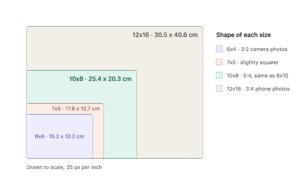
standard photo print sizes comparison

Why Standard Photo Print Sizes Have Different Shapes

Standard photo print sizes differ in shape as well as size, and this matters more than most people expect.

  • 6×4 (3:2) has the same shape as most traditional and DSLR camera photos, so these usually print with no cropping.
  • 7×5 and 10×8 are slightly squarer, so a camera photo printed at these sizes loses a sliver from the edges.
  • 12×16 (3:4) has the same shape as most smartphone photos. That makes it a great size for printing phone pictures large without cutting off anyone’s head.

Before you order prints, check the crop preview on your photo lab’s website. If something important is close to the edge, choose the size whose shape is closest to your original.

6×4: The Classic Everyday Print

At 6×4 inches (about 15 x 10 cm), this is the most popular of all the standard photo print sizes in the UK. It’s what high-street kiosks and most online labs print by default. It’s ideal for holiday snaps, family albums and filling a shelf with small memories.

Which frame fits a 6×4 print? A 6×4 photo frame holds it edge to edge. For a gallery-style look, choose a 7×5 or 8×6 frame with a mount cut for a 6×4 photo. The border draws the eye in and makes a small print look far more considered.

Where it works best: desks, bookshelves, mantelpieces, and clusters of three or five frames.

You’ll find 6×4 options in our mini picture frames and photo frames and rectangle picture frames.

7×5: The Perfect Gift Size

A step up from 6×4, a 7×5 print (about 18 x 13 cm) has just enough extra size to feel special. It’s a favourite for framed gifts, newborn photos, engagement shots and wedding thank-you presents.

Which frame fits a 7×5 print? A 7×5 frame fits it exactly. For a bigger presence on a wall or sideboard, use a 10×8 frame with a 7×5 mount.

Where it works best: bedside tables, hallway consoles, and as the “middle” size in a gallery wall.

8×10 and 10×8: Same Print, Two Ways Round

This is the size that confuses people most, so here’s the key fact: 8×10 and 10×8 are exactly the same size, about 20 x 25 cm. The only difference is orientation.

  • 8×10 usually describes a portrait (upright) print, such as a school photo, headshot or family portrait.
  • 10×8 is the common UK way of writing the size. It’s often used for landscape (sideways) prints such as group photos, pets and scenery.

Of all the standard photo print sizes, this is the most versatile mid-sized option. It’s big enough to hang on its own and small enough to group with others.

Which frame fits an 8×10 or 10×8 print? A single 10×8 frame fits both, because most of our rectangle frames hang either way. If you want a mount around an 8×10 print, step up to a 12×16 (16×12) frame.

12×16: Go Big With Your Favourite Photo

A 12×16 print (about 30 x 40 cm) is the largest of the standard photo print sizes in this guide. At this size, a photo starts to feel like proper wall art. It suits wedding photos, travel landscapes and favourite family portraits.

Because 12×16 has the same 3:4 shape as most smartphone cameras, it’s the best size for printing a phone photo large without awkward cropping. At this size, a high-resolution original will look noticeably sharper.

Which frame fits a 12×16 print? A 16×12 frame holds it edge to edge, since the size is the same whichever way round the numbers are written. For a mounted look, choose a 20×16 frame with a 12×16 mount.

Where it works best: above a sofa, bed or fireplace, or as the centrepiece of a gallery wall.

Should You Add a Mount?

A mount (sometimes called a matte) is the card border between your photo and the frame. It’s optional, but it can transform how a print looks. Here’s how to pair standard photo print sizes with mounted frames:

Your print Frame with mount
6×4 7×5 or 8×6 frame
7×5 10×8 frame
8×10 / 10×8 12×16 (16×12) frame
12×16 20×16 frame

Mounts are especially handy when a print isn’t quite a standard size, because the mount’s window covers the edges and hides any small trimming.

How to Measure Your Print Correctly

Even with standard photo print sizes, it’s worth measuring before you buy:

  1. Lay the print flat and measure its width and height.
  2. Measure the actual image, not any white border the lab has added, unless you want the border to show.
  3. Match those measurements to the frame size. On PhotoFramed, the frame size is the size of the picture it holds.
  4. If your print is in centimetres or an A-size, check our picture frame sizes UK chart or our guide to A-series photo frame sizes.

Mixing Standard Photo Print Sizes on a Gallery Wall

An easy way to make a gallery wall look balanced is to combine two or three standard photo print sizes in the same frame colour. A good starting formula is:

  • one 12×16 frame as the centrepiece
  • a 10×8 frame on either side
  • 7×5 and 6×4 frames to fill the gaps

For step-by-step layout tips, read our guide on how to create a gallery wall.

Need inspiration for mixing standard photo print sizes? Browse our PhotoFramed Pinterest board for gallery wall layouts, frame pairings and styling ideas.

Frequently Asked Questions

What are the most common standard photo print sizes in the UK?
The most common standard photo print sizes in the UK are 6×4, 7×5, 10×8 (also written 8×10) and 12×16. A4 is also common for documents and certificates.

Is 10×8 the same as 8×10?
Yes, they’re identical in size. 10×8 usually describes landscape prints and 8×10 portrait prints, and one 10×8 frame fits both.

What frame do I need for a 6×4 photo?
A 6×4 frame fits it exactly. For a mounted look, use a 7×5 or 8×6 frame with a 6×4 mount.

What size should I print phone photos?
Phone photos are usually 3:4 in shape, so a 12×16 print will crop little or nothing. Smaller standard photo print sizes such as 6×4 will crop a little from the top and bottom.

Do frame sizes include the frame border?
No. At PhotoFramed, the frame size is the size of the picture it holds, so a 7×5 frame takes a 7×5 print.

Find the Right Frame for Your Print

Once you know your print size, choosing a frame is easy. Whether you have a stack of 6×4 holiday snaps or one show-stopping 12×16 portrait, we stock frames for all the standard photo print sizes. We also carry more than 100 other sizes in inches, centimetres and A-sizes, with fast UK delivery and 30-day returns.

Browse all frame sizes or shop all frames. If you’re unsure which size to pick, contact our team and we’ll be happy to help.

Continue Reading →
What Our Clients Say
2 reviews